 English
Views: 107 Author: Site Editor Publish Time: 2026-01-16 Origin: Site




If you’ve listened to enough exhaust clips, you’ve seen the debate: X-pipe vs H-pipe gets heated fast. One person says H-pipe is the only “real” muscle sound. Another says X-pipe is smoother, cleaner, and feels stronger up top. Then someone drops “just use a Y-pipe” and the whole thread goes sideways.
Here’s the truth: all three can be the right answer—because a crossover isn’t a magic horsepower part. It’s a tuning tool. It changes how exhaust pulses interact, which changes tone, rasp, drone tendency, and how the car feels through the rev range.
True dual V8: choose based on sound first (classic rumble = H, smoother blend = X), then tune comfort with resonators and mufflers.
V6/turbo/single-exit merges: you’re usually in Y-pipe territory—merge quality matters more than forum opinions.
GRWA tip: Fitment matters. If you’re not 100% sure what’s under your car, one quick under-car photo of the mid-pipe area usually tells us what crossover style actually fits.
Crossover Type | Sound Character | Drone/Rasp Tendency (Typical) | “Power Feel” Tendency | Best Fit |
X-Pipe | Smoother blend, cleaner top-end | Can get sharper if the system is too open | Often feels better at higher RPM | V8 performance builds, some V6 dual setups |
H-Pipe | Deeper, classic rumble | Often calmer up top; can still drone if the rest is deleted | Often feels strong in the mid-range | V8 street builds, classic muscle tone |
Y-Pipe | Depends on merge + downstream parts | Good merge helps avoid turbulence/rasp | Best for merging/packaging | V6, turbo layouts, single-exit systems |
Want classic deep rumble? Start with an H-pipe.
Want smoother, refined top-end? Start with an X-pipe.
Need to merge into a single system? Choose a quality Y-pipe.
If you’re still choosing overall system type, see our guide:Cat-Back vs Axle-Back Exhaust: Sound, Power & Cost Comparison
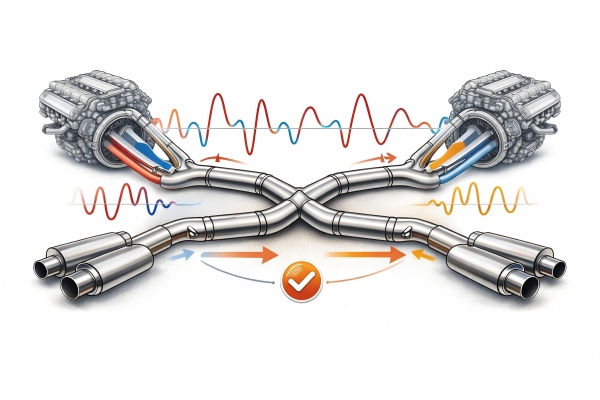
Engines push exhaust in pulses, not a steady stream. On true duals, each bank sends pulses down its own side. A crossover lets those pulses “talk,” which can:
smooth the note (less choppy, more blended)
shift frequencies that create rasp or dron
sometimes improve scavenging depending on placement and overall layout
Think “pulse mixing,” not “free horsepower.”
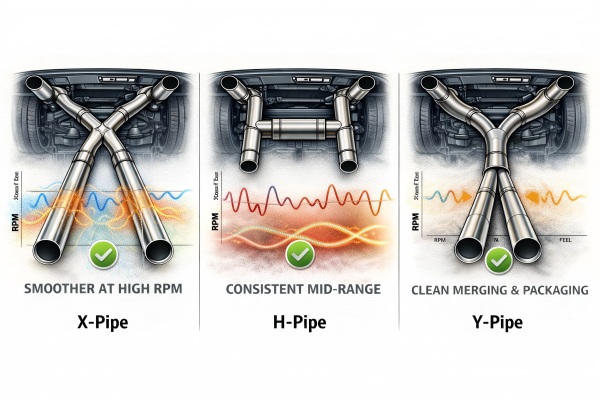
Typically smoother at high RPM, cleaner transitions
If the rest of the exhaust is extremely open (tiny resonator + aggressive mufflers), it can sound cleaner but a bit sharper—add tuning volume.
Deeper rumble, more traditional “separate bank” character
Usually calmer top-end than an X; great for street-driven V8s.
Used when two paths must become one (many V6/turbo/single-exit layouts)
A good merge keeps flow smooth and sound controlled; a bad merge can create turbulence and rasp.
Part | What it changes most | What it doesn’t decide |
X / H / Y crossover | Tone character and smoothness | Overall volume (mostly mufflers/resonators) |
Mufflers/resonators | Volume, comfort, highway livability | Basic character shaped by crossover |
Quick sound summary | Typical description |
X | Cleaner, smoother, refined at high RPM |
H | Deeper rumble, classic muscle |
Y | Depends on merge + downstream parts; often best choice on V6/turbo |
If your goal is “louder but still sounds good,” see: How to Make Exhaust Louder | Performance Exhaust Upgrade.
If you’re swapping only the crossover, don’t expect a dramatic dyno chart. On many street builds, changes are modest on paper, but more noticeable in:
smoother pull at higher RPM
more consistent torque feel
throttle response when the rest of the exhaust is already opened up
Typical trend (not a promise): X tends to suit higher-RPM flow behavior, H often feels strong mid-range, Y is about clean merging and packaging.
Engine layout | Best starting point | Notes |
V8 (true dual) | X for refined top-end / H for classic rumble | Mostly a sound preference first |
Inline-6 | Tune resonator/muffler first | Crossover type often less dominant |
Inline-4 (especially turbo) | Focus on downpipe/resonator/muffler + avoid oversized pipe | Layout/diameter matters most |
V6 | Usually Y-pipe | Merge quality + downstream tuning matter most |
Note: X vs H is mainly a true-dual discussion. If your platform is designed to merge (many V6 and turbo layouts), a well-designed Y merge is usually the right answer.
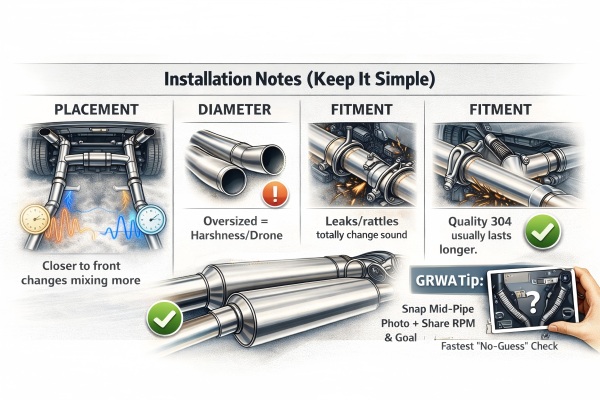
Placement matters: closer to the front often changes pulse mixing more, but space/heat limits apply.
Don’t oversize pipe diameter: it can add harshness/drone without real gains.
Fitment matters: leaks and rattles can completely change sound.
Material: quality stainless (often 304) lasts longer in daily use.
Recipe | Best for | Crossover choice | Supporting parts | Result |
Daily Comfort | Long highway drives, trucks, family cars | V8: H / V6: quality Y | Real resonator + comfort mufflers | Deep tone, minimal drone |
Sporty Street | Most daily-driven builds | V8: X (or H for more rumble) | Moderate resonator + packed mufflers | Strong under throttle, controlled at cruise |
Aggressive Weekend | Weekend cars, louder setups | V8: X | Smaller resonator + freer mufflers (don’t delete tuning volume) | Loud, sharper, cleaner up top |
Does an X-pipe sound better than an H-pipe?
Depends on taste. X is usually smoother/cleaner up top; H is deeper and more classic.
Will an X-pipe add horsepower?
Sometimes a little on higher-flow builds, but most people notice sound + high-RPM feel more than peak numbers.
Is an H-pipe better for low-end torque?
It can feel stronger mid-range on some setups, but placement and diameter matter as much as crossover type.
When should you use a Y-pipe instead of an X-pipe or H-pipe?
Use a Y-pipe when you need to merge into a single system—common on many V6, turbo, and single-exit layouts.
Is an X-pipe louder than an H-pipe?
Neither is automatically louder. Mufflers/resonators control volume; the crossover mostly shapes tone and smoothness.
Want the right answer fast without guessing? Send us one under-car photo of the mid-pipe area plus your engine layout and sound goal. We’ll confirm whether X/H/Y actually fits your routing—and recommend a combo that sounds right on the road, not just in a clip.


