 English
Views: 14 Author: Site Editor Publish Time: 2026-10-13 Origin: Site


 Choosing exhaust tubing affects weld consistency, installation, product weight and long-term service performance. For an overseas exhaust brand or distributor, the useful question is which tube specification will meet the intended application and remain consistent through repeat orders. An automotive exhaust system needs exhaust pipes matched to its operating conditions. A seamless tube can solve particular manufacturing challenges; a properly specified welded tube can also be a practical choice.
At GRWA, we support OEM exhaust manufacturing and custom exhaust fabrication, from custom exhaust headers to a full exhaust system. This guide explains how to compare tube construction, material grades and exhaust pipe wall thickness before approving a drawing or requesting a sample.
Seamless exhaust tubing is produced without a longitudinal weld seam. Welded exhaust tubing is formed from strip and joined along its length. Depending on the manufacturing route, welded tube can receive further drawing, heat treatment or surface processing. Buyers should compare the finished specification and inspection evidence for exhaust pipes rather than judging a tube by its manufacturing label alone.
A longitudinal seam deserves attention when reviewing weld quality and corrosion exposure. However, seamless construction does not remove the assembly welds at collectors, flanges, brackets or sensor bungs. An exhaust header still needs its welded construction evaluated at every joined feature. Either type of exhaust tubing can develop problems if the alloy is unsuitable, the bend is excessively thinned, or the completed system is restrained as it expands.
For a purchasing team, this changes the supplier discussion. Ask about material identification, dimensional tolerances and seam condition where applicable. Then evaluate how the exhaust tubing behaves after bending and joining. A quotation for exhaust pipes that names only stainless steel leaves too many variables open for a repeatable production program.
Stainless steel exhaust tubing should be specified by grade, wall thickness and condition. A polished stainless steel surface identifies a finish; it does not establish corrosion resistance or suitability for continuous high-temperature operation. Road salt, exhaust condensate, operating temperature and cleaning practices all influence the material decision for exhaust pipes.
Material option | Purchasing consideration | Specification to confirm |
409 stainless steel | An established option for cost-sensitive automotive exhaust applications; visible surface oxidation may occur | Grade, finish expectations and exposure conditions |
304 stainless steel | Common in performance exhaust fabrication where appearance and corrosion resistance matter | Exact grade, thickness, weld procedure and mirror polished or brushed finish |
Titanium alloy | Useful where assembly weight is a priority | Alloy grade, temperature suitability, joint design and welding controls |
Stabilized stainless steel or nickel alloy | Consider for demanding thermal duty after an engineering review | Qualified material, manufacturing route and validation requirements |
A 304 stainless steel exhaust and a 409 stainless steel exhaust can serve different market positions. For a titanium exhaust system, confirm the titanium alloy and intended temperature exposure as well as the weight target. For sustained severe thermal duty, ask whether the selected alloy and joint design are appropriate. Increasing the exhaust tubing thickness alone cannot compensate for every material limitation. Specialty alloy availability should be reviewed for the individual project.
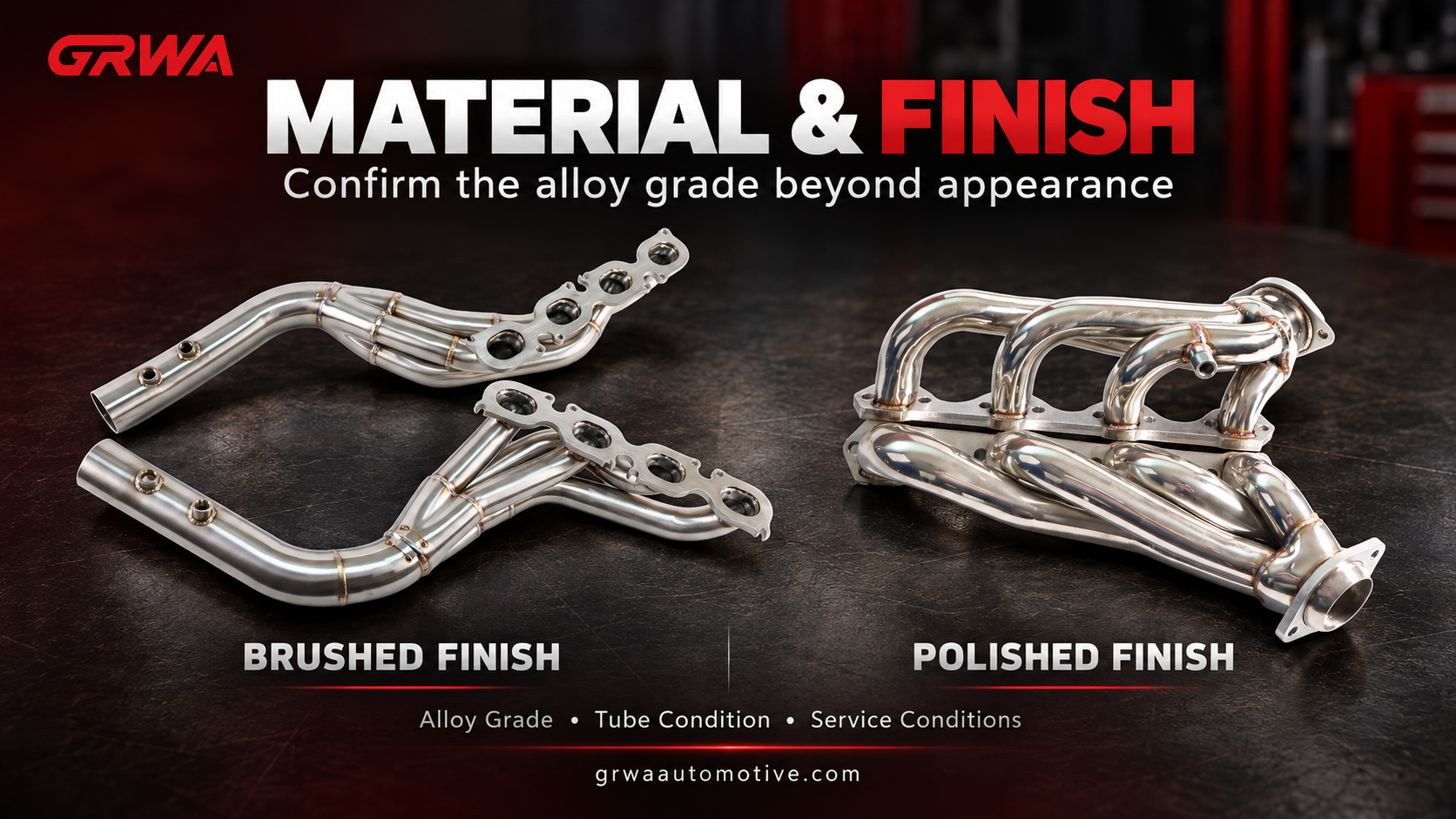
There is no single wall thickness that works for every exhaust header, downpipe or midpipe. Tube diameter, unsupported length, bracket locations, vibration, fabrication method and thermal cycling all matter. Long tube headers and a compact exhaust manifold can impose different loads because their lengths and supports differ. Specify the wall of exhaust pipes in millimeters or inches, since gauge labels can be interpreted differently across materials and suppliers.
Fabricated performance headers are sold in wall sizes such as 0.049 inch and 0.065 inch, approximately 1.24 mm and 1.65 mm. These examples show why a blanket recommendation of 2.5 to 3.5 mm for every header or downpipe would be misleading. They are reference sizes, not a GRWA approval for a particular vehicle or operating condition.
Use the following matrix to organize an exhaust tubing discussion with the manufacturer. For a catback exhaust system, review the connecting pipes together with the muffler and hanger layout. The final drawing should state the selected wall, tolerance and minimum acceptable wall after forming.
Exhaust section | Main design concern | Review before choosing the wall |
Exhaust header or downpipe | Thermal cycling, flange loading and nearby heat exposure | Alloy, bend radius, supports, flex section and weld layout |
Catback exhaust system pipes | Vibration, ground clearance and unsupported span | Hanger positions, joint locations and installed clearance |
Stainless steel muffler connections | Repeated loads at joints and brackets | Connection fit, reinforcement and assembly movement |
Exhaust muffler shell or exhaust tip | Shape retention, finish and handling damage | Forming method, shell structure and cosmetic standard |
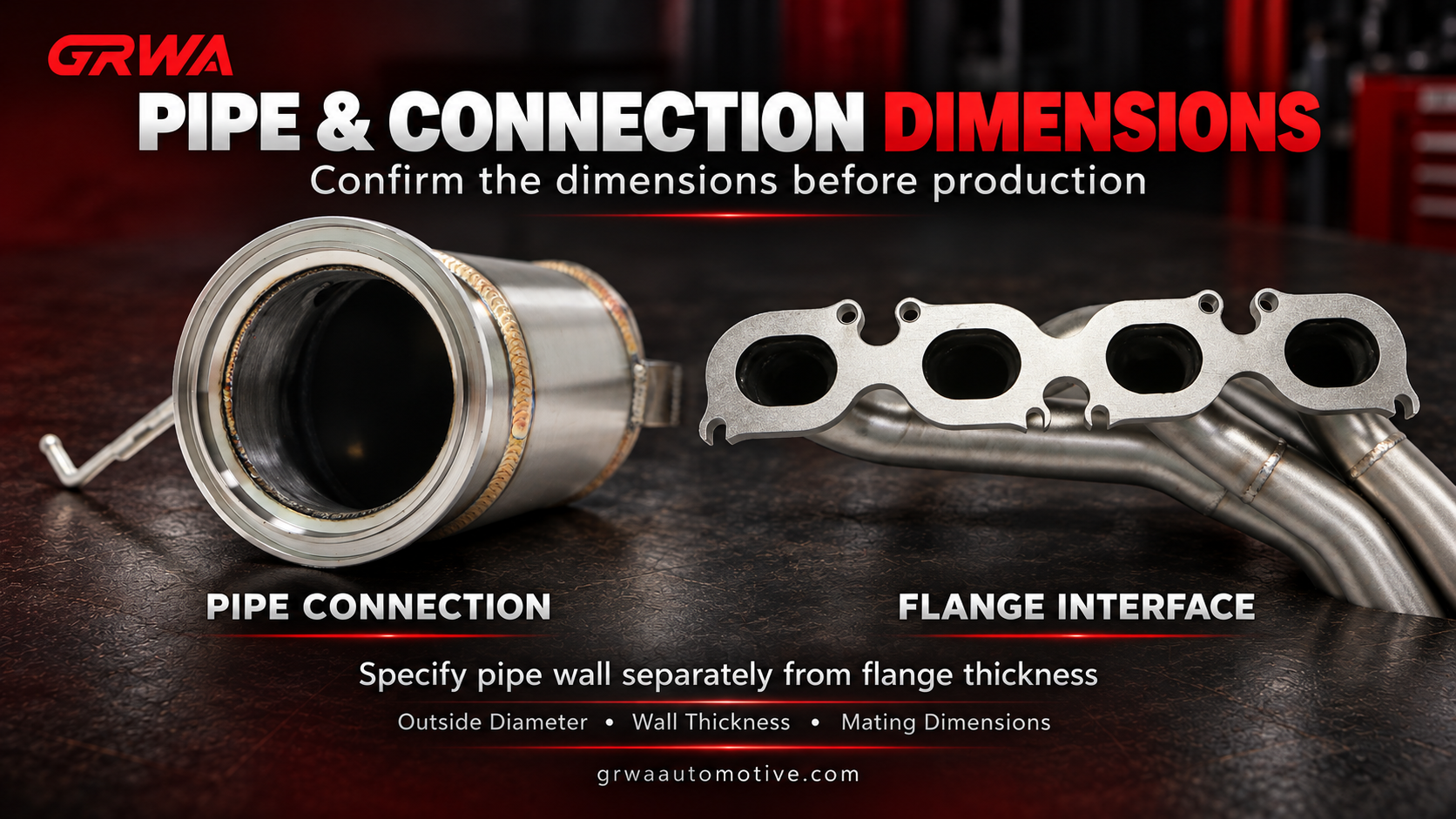
Distinguish an exhaust pipe wall from a flange, cast collector or muffler shell. A thick flange dimension should never be copied into an exhaust tubing specification. For a Z pipe exhaust crossover, identify whether the central section is cast, additively manufactured or fabricated. Exhaust pipes and crossover bodies require their own dimensions and inspection criteria.
When sourcing exhaust tubing, confirm whether a quoted diameter is outside diameter or inside diameter. At the same outside diameter, a thicker wall reduces the available internal area. This distinction matters when exhaust pipes connect to a downpipe, exhaust manifold or muffler.
For example, a round tube with a 76.2 mm outside diameter has a nominal inside diameter of 73.2 mm at a 1.5 mm wall, or 70.2 mm at a 3.0 mm wall. The thicker version has approximately 8% less internal cross-sectional area. This is a geometry comparison; it does not predict an 8% change in engine power or pressure drop.
Transitions, bend geometry, catalytic converters and muffler passages also affect the complete exhaust system. The inlet and outlet of a high flow catalytic converter should be checked against the adjoining exhaust pipes. A flow-related product description alone establishes neither catalyst approval nor a power gain. Specify exhaust tubing dimensions alongside these components so the production drawing reflects the intended flow path.
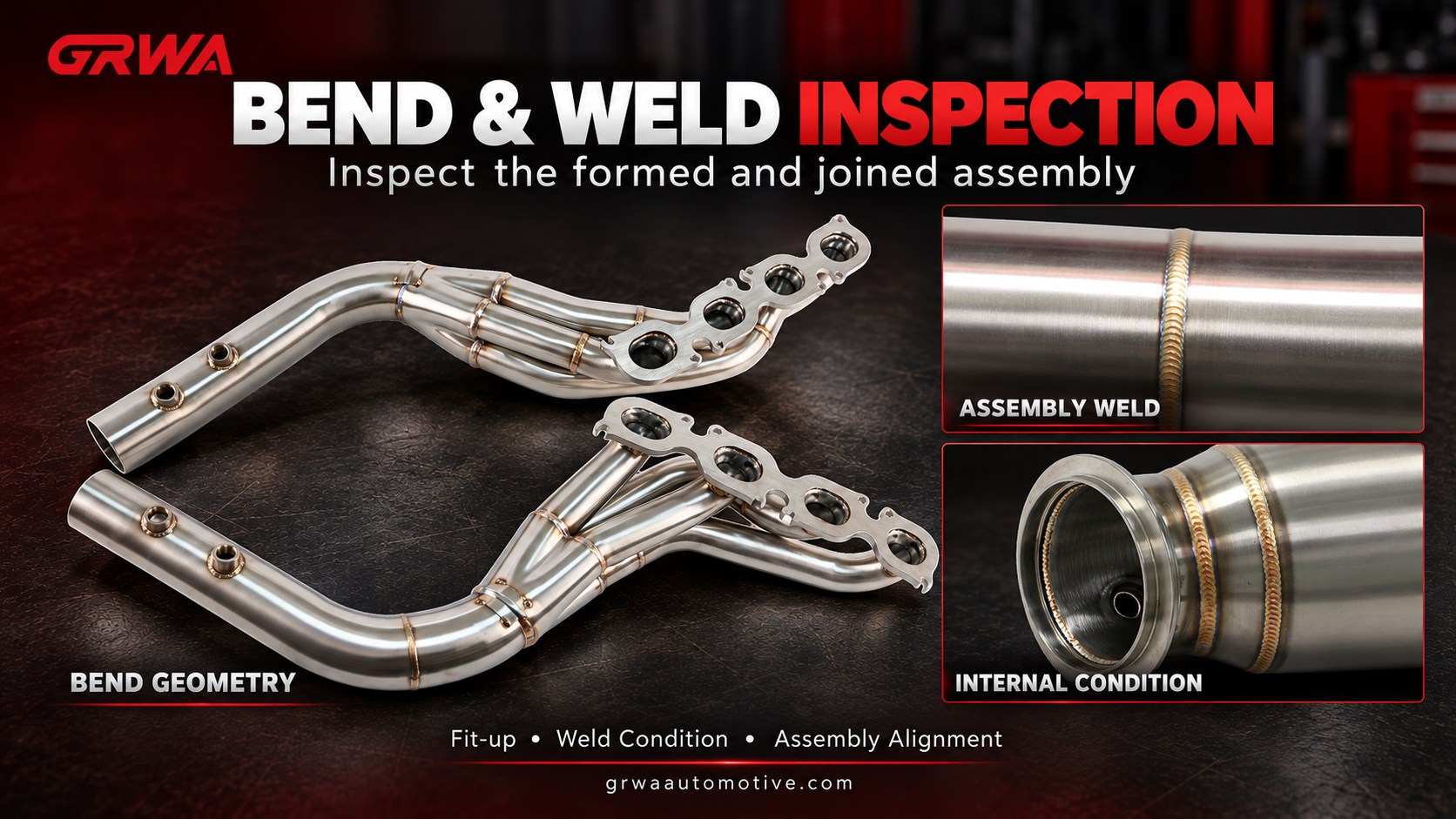
Mandrel bending helps support the exhaust tubing during forming, but buyers should still review ovality, wrinkling and local thinning at the bend. Tight packaging can require a different bend radius, wall specification or component layout. Check the formed exhaust pipes against the approved drawing rather than relying only on a straight-tube certificate.
TIG welding is widely used in performance exhaust fabrication. The useful acceptance criteria include fit-up, penetration, internal condition and dimensional stability. Appropriate shielding and back purging should be defined for the alloy and joint. Decorative weld color alone does not demonstrate joint quality.
GRWA supports customization of pipe geometry, connection details and finished assemblies. For a repeatable exhaust tubing program, agree the critical dimensions, weld acceptance, leak checks and finish requirements during sample development. Customized exhaust pipes should follow the same approved drawing and sample revision when the product moves into production.
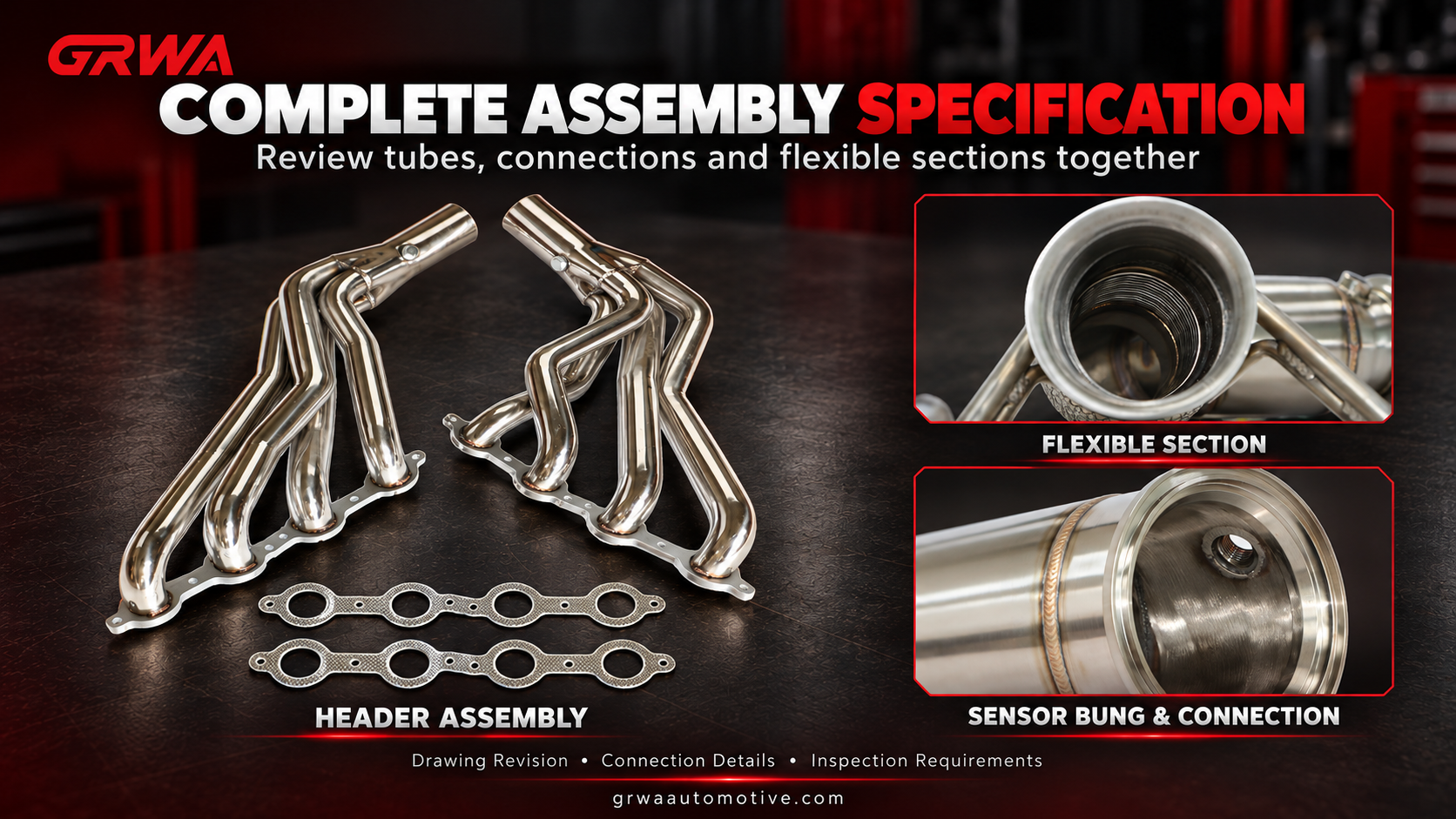
Performance exhaust systems combine components that face different loads and temperatures. Exhaust tubing for a straight section cannot be specified in isolation from flexible joints, an exhaust muffler or the visible tail pipe. Review the connecting exhaust pipes and each component construction separately.
An exhaust flexible pipe needs a specification for its bellows, braid, internal liner and connecting ends. When evaluating a stainless steel flexible exhaust pipe, confirm the overall length, flexible section length, bore and permitted movement. A flexible corrugated exhaust pipe should also be assessed for fatigue and installation alignment. Its individual layers should not be described using only the wall thickness of the adjoining exhaust tubing.
A stainless steel muffler uses a shell and connecting tubes with separate manufacturing requirements. A performance muffler also needs defined internal passages, mounts and acceptable sound behavior. For a valved muffler, include actuator clearance and valve movement in the assembly review. The valve and pipe layout should permit the intended flow route in each operating state.
An exhaust tip is a visible finishing component, while a tail pipe forms part of the outlet layout. For a custom exhaust tip, agree the inlet connection, overall length and finish sample. Dual exhaust tips need consistent spacing and alignment as well as suitable supports. Specify the material beneath the finish, since appearance alone does not verify alloy grade or service durability.
Send the following information when requesting stainless steel exhaust tubing, exhaust pipes or a complete fabricated assembly:
Material grade, outside diameter, wall thickness and dimensional tolerance.
Vehicle application or drawing number, including the drawing revision.
Bend radii, flange details, sensor positions, mating connections and included exhaust accessories.
Intended operating conditions, weight target and finish requirements.
Sample quantity, expected order volume and packaging requirements.
A complete request makes it easier to compare quotations for exhaust pipes on the same basis. It also helps identify whether seamless exhaust tubing offers a useful advantage for the design or whether a qualified welded tube is suitable.
Is seamless exhaust tubing always more durable?
No universal durability advantage can be assumed. Compare the alloy, tube quality, formed geometry and complete assembly under the intended service conditions. Seamless construction removes the longitudinal tube seam, while flanges and other joined components still require qualified fabrication. The durability of exhaust pipes depends on the complete specification and its validation.
Does a thicker tube always improve a performance exhaust?
A thicker tube changes stiffness, weight, forming behavior and internal diameter. The appropriate choice depends on the design and validation results. Specify the required wall instead of selecting the heaviest option by default.
Can GRWA customize the tube and connection dimensions?
We support OEM and ODM development of exhaust components and assemblies. Submit your drawings or physical sample so we can review the material, connection geometry, manufacturing route and inspection requirements for your project.
Does universal fit mean fabrication is unnecessary?
A universal fit label does not confirm every vehicle connection or mounting position. For exhaust pipes and fabrication components, check the mating dimensions, installed space and support layout before purchase. Professional installation should follow the approved configuration.
Request an exhaust tubing specification review?
Share your exhaust tubing drawing, target application and expected order volume with GRWA. Include the exhaust pipes, connection details and any flexible section, muffler or tip requirements. We can review the proposed manufacturing approach and discuss material, wall thickness, fabrication and private label packaging. Include the relevant mating-part dimensions so the quotation addresses a complete, installable assembly.
Share your exhaust tubing drawings or sample specifications with GRWA's engineering team to validate your design and receive a formal OEM/ODM quotation.


